How the Piano Works: An Introduction to the Instrument
The term piano encompasses two primary types of keyboard instruments: the grand piano and the upright piano. While they differ in size and appearance, both share the same fundamental design principles and sound production mechanism.
What’s Under the Lid?
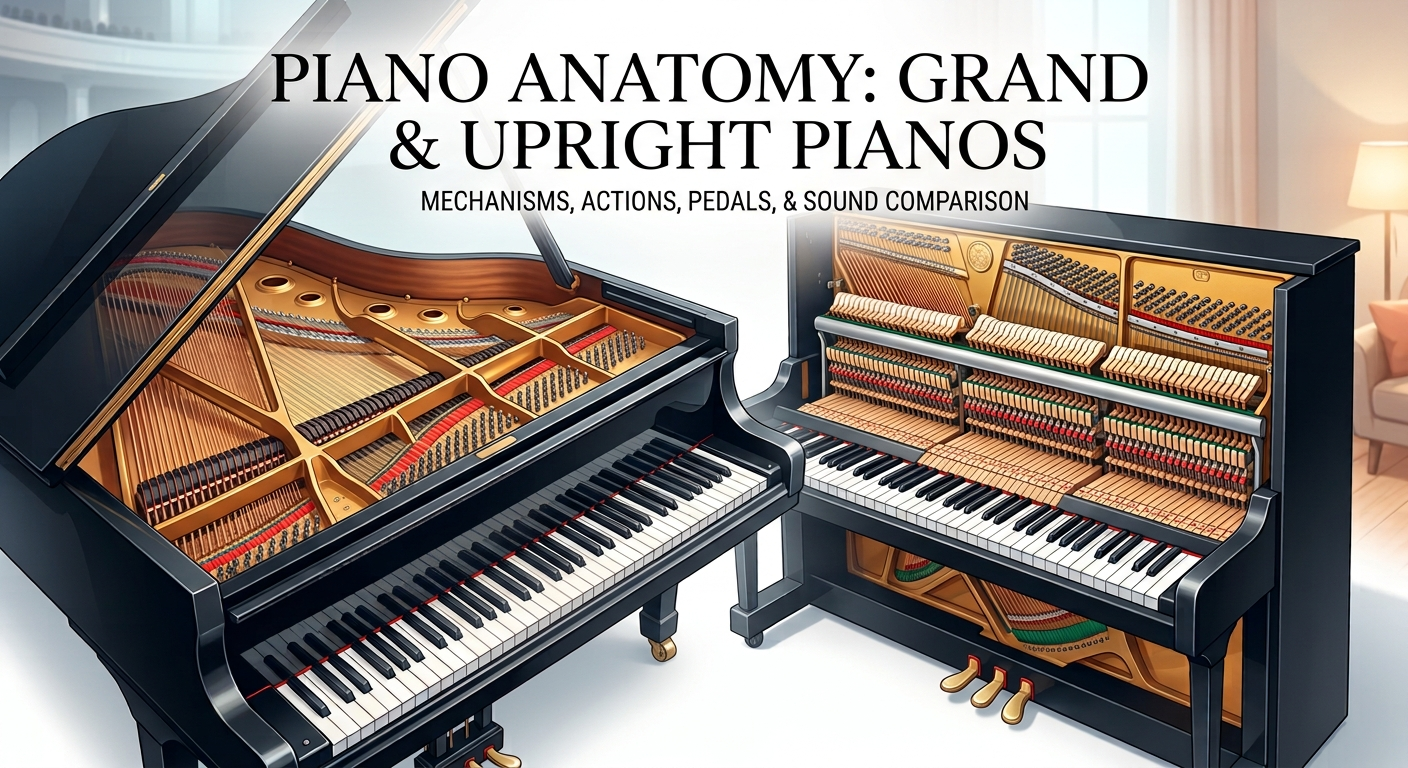
If you open the lid of a piano, you will see dozens of steel strings stretched tightly across a massive cast-iron frame.
Looking at the layout from left to right:
- Bass (Left): The strings are long and thick, producing deep, powerful low tones.
- Treble (Middle to Right): The strings become progressively thinner and shorter, creating higher-pitched sounds.
Not every key controls the same number of strings:
- Lowest notes: 1 thick string per key.
- Mid-range notes: 2 strings per key.
- Higher notes: 3 unison-tuned strings per key.
Directly beneath the strings sits the soundboard, a large board made of spruce wood. Its job is to amplify the relatively quiet vibrations of the strings, giving the piano its rich, audible tone.
Keyboards and Action Mechanics
The keyboard consists of a row of black and white keys positioned at the front of the instrument, protected by a hinged wooden cover.
Behind the keys lies a sophisticated mechanical system called the action.
How Sound Is Produced
- The Touch: When a pianist presses a key, a system of levers propels a felt-padded wooden hammer toward the corresponding strings.
- The Impact: The hammer strikes the strings, causing them to vibrate and produce sound.
- Dynamic Control: A gentle touch produces a soft, quiet strike. A stronger press generates a louder, more brilliant sound.
- The Release: Immediately after striking the string, the hammer bounces back, allowing the string to vibrate freely.
Dampers: Controlling Sound Duration
To prevent notes from ringing indefinitely, the piano uses dampers—small wooden blocks with soft felt pads that rest directly on top of the strings.
- When a key is pressed: The damper lifts off the string, allowing it to vibrate freely when struck by the hammer.
- When the key is released: The damper drops back down onto the string, instantly stopping the vibration and hushing the sound.
Note: The highest treble notes do not have dampers. Because these short strings naturally stop vibrating very quickly, dampers are not needed.
Understanding Piano Pedals
Pianos feature two (sometimes three) foot pedals located near the base of the instrument.
1. The Right Pedal (Sustain Pedal)
The right pedal controls the damper mechanism. When pressed, it lifts all the dampers off the strings simultaneously. This allows the notes to sustain and ring out freely, even after the pianist releases the keys.
2. The Left Pedal (Una Corda / Soft Pedal)
The left pedal reduces the volume and softens the tone of the instrument:
- On a Grand Piano: Pressing the pedal shifts the entire keyboard and hammer mechanism slightly to the right. As a result, the hammers strike only one or two strings instead of three, creating a muted, warmer tone.
- On an Upright Piano: Pressing the pedal moves the hammers closer to the strings, reducing the distance of the strike and softening the overall sound.
Grand Pianos vs. Upright Pianos
While both instruments function similarly, their physical designs set them apart:
| Feature | Grand Piano | Upright (Vertical) Piano |
|---|---|---|
| String Layout | Horizontal | Vertical |
| Soundboard Size | Larger | Smaller |
| Tone Quality | Richer, more powerful sound | Compact sound suited for smaller spaces |
| Best Used For | Concert halls, studios, large venues | Homes, schools, practice rooms |