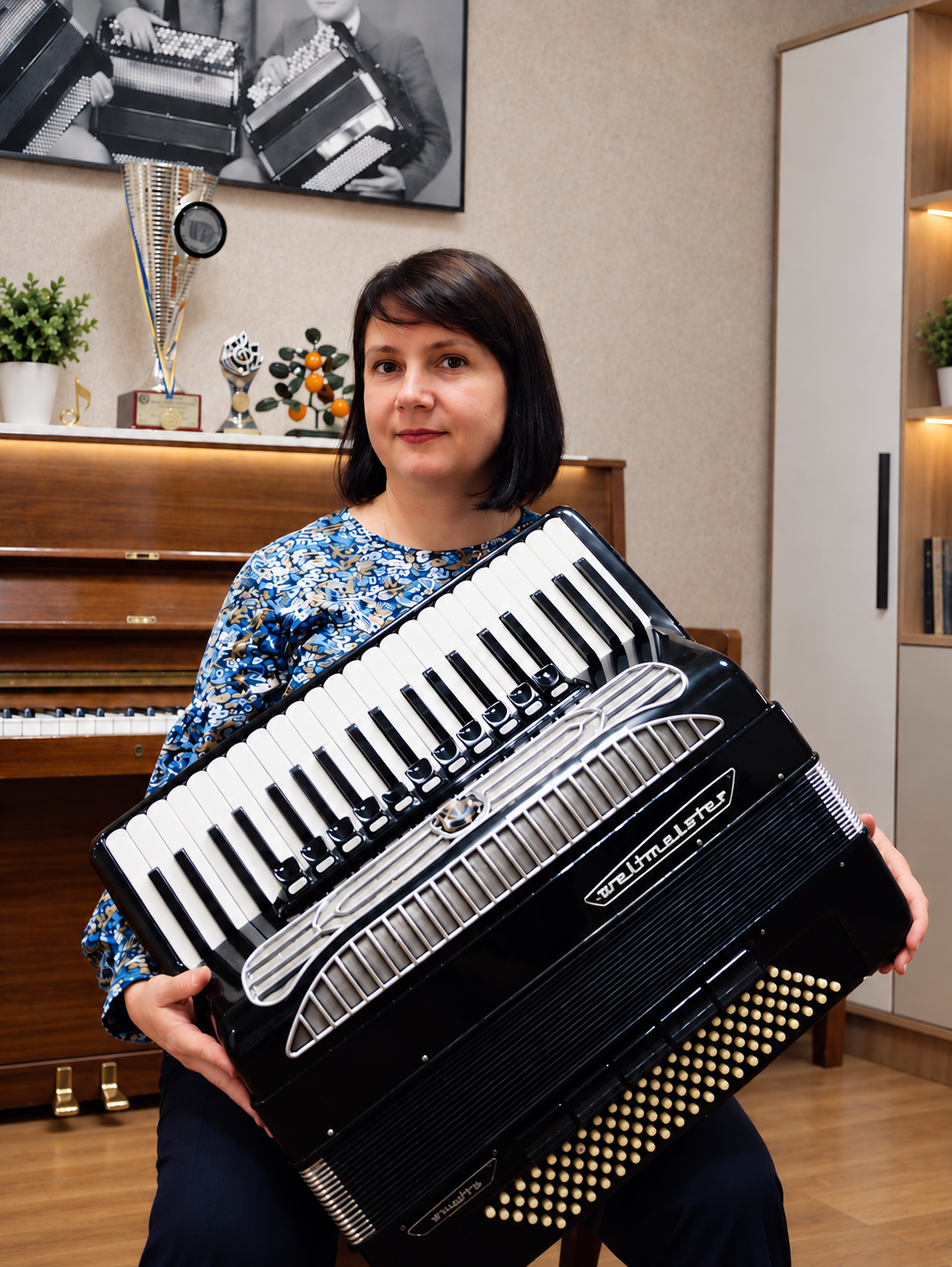
Hello! My name is Natalya Chobanu, and music has been an important part of my life for many years — as a teacher, performer, accompanist, and musician.
For me, teaching music is much more than helping a student learn notes or master an instrument. It is about developing musical thinking, sensitivity, discipline, confidence, and the ability to express emotions through sound.
Throughout my professional career, I have worked with students of different ages, abilities, and musical backgrounds. I believe that every student has their own pace of development, personality, and musical potential. My task as a teacher is to recognize that potential and help it grow.
I especially value an atmosphere of patience, mutual respect, and encouragement. A student should not be afraid of making mistakes — mistakes are a natural part of learning and an important step toward progress.
Professional Credo
“Everything I do, I strive to do well.”
This principle guides both my work as a musician and my relationship with my students. I believe that meaningful results are achieved through patience, consistency, attention to detail, and a genuine love for what we do.
Life Principle
“So in everything, do to others what you would have them do to you, for this sums up the Law and the Prophets.” — Matthew 7:12
For me, this principle is especially important in teaching. A teacher does more than share knowledge. A teacher can encourage, inspire, build confidence, and influence the way a student sees their own abilities.
That is why I strive to treat every student with kindness, patience, respect, and understanding.
Qualification: Highest Pedagogical Qualification Category
I have a higher degree in music and professional qualifications covering several important areas of musical education and performance:
Music Education and Pedagogy
Accordion Performance
Orchestra and Ensemble Performance
Conducting of Folk Instruments Orchestra
Accompaniment
Music Theory and Professional Musical Disciplines
I hold the Highest Pedagogical Qualification Category, which reflects extensive professional experience, strong methodological preparation, and a long-term commitment to music education.
My professional background allows me to approach music comprehensively. In addition to instrumental technique, I help students understand musical form, rhythm, phrasing, harmony, dynamics, and the character of a composition.
This broader musical foundation helps students not simply reproduce notes, but understand what they are playing and how to make the music meaningful.
My teaching approach combines the traditions of classical music education with an individual and supportive approach to every student.
1. Individual Learning Path
Every student is different. I take into account their age, previous experience, musical abilities, goals, and preferred learning pace.
Whether a student is taking their first steps in music or already has experience with the instrument, lessons are adapted to their current level and personal objectives.
2. Strong Technical Foundation
Good technique creates freedom.
From the beginning, we work carefully on posture, hand position, coordination, bellows control, articulation, rhythm, and sound production. Developing correct habits helps students progress more confidently and prevents technical difficulties later.
3. Musicality, Not Just Notes
Learning the correct notes is only the beginning.
I encourage students to listen closely to themselves, understand musical phrases, recognize the mood and character of a piece, and learn how to communicate emotion through their performance.
The goal is not simply to play correctly, but to play musically.
4. Step-by-Step Progress
Complex skills become much easier when they are divided into clear and achievable steps.
During lessons, we gradually move from simple tasks to more advanced material so that students can see their own progress and build confidence in their abilities.
5. Encouragement and Respect
I believe that students achieve their best results when they feel supported.
A warm and respectful learning environment helps students ask questions freely, experiment, overcome difficulties, and enjoy the process of making music.
Accordion
Development of fundamental and advanced accordion technique, including correct posture, coordination of both hands, bellows control, articulation, dynamics, and expressive performance.
Reading Sheet Music
Developing confident music-reading skills and learning to understand rhythm, notation, musical symbols, phrasing, and structure.
Technique Development
Exercises and repertoire selected to improve finger independence, coordination, accuracy, rhythmic stability, mobility, and control of the instrument.
Musical Expression
Learning how to work with dynamics, articulation, phrasing, tempo, and musical character so that every performance sounds expressive rather than mechanical.
Music Theory
Practical understanding of scales, intervals, chords, rhythm, musical forms, and other theoretical concepts directly connected with the repertoire being studied.
Ensemble Skills
Developing the ability to listen to other musicians, maintain rhythm and tempo, understand one’s role within an ensemble, and perform as part of a unified musical group.
Performance Preparation
Preparation for concerts, examinations, auditions, school performances, church events, and other public performances.
Special attention is given not only to the repertoire itself, but also to confidence, concentration, musical continuity, and stage presence.
“Music teaches us not only to hear sounds, but to listen, feel, think, and express what words cannot always say. I believe that every student has musical potential, and my goal is to help them discover it. Together, step by step, we can turn difficulties into achievements and notes into real music.”
Whether your goal is to learn the accordion from the beginning, improve your existing skills, prepare for a performance, or simply discover the joy of making music, I will be happy to guide you on this journey.
Hello! My name is Natalya Chobanu, and music has been an important part of my life for many years — as a teacher, performer, accompanist, and musician.
For me, teaching music is much more than helping a student learn notes or master an instrument. It is about developing musical thinking, sensitivity, discipline, confidence, and the ability to express emotions through sound.
Throughout my professional career, I have worked with students of different ages, abilities, and musical backgrounds. I believe that every student has their own pace of development, personality, and musical potential. My task as a teacher is to recognize that potential and help it grow.
I especially value an atmosphere of patience, mutual respect, and encouragement. A student should not be afraid of making mistakes — mistakes are a natural part of learning and an important step toward progress.
Professional Credo
“Everything I do, I strive to do well.”
This principle guides both my work as a musician and my relationship with my students. I believe that meaningful results are achieved through patience, consistency, attention to detail, and a genuine love for what we do.
Life Principle
“So in everything, do to others what you would have them do to you, for this sums up the Law and the Prophets.” — Matthew 7:12
For me, this principle is especially important in teaching. A teacher does more than share knowledge. A teacher can encourage, inspire, build confidence, and influence the way a student sees their own abilities.
That is why I strive to treat every student with kindness, patience, respect, and understanding.
Qualification: Highest Pedagogical Qualification Category
I have a higher degree in music and professional qualifications covering several important areas of musical education and performance:
Music Education and Pedagogy
Accordion Performance
Orchestra and Ensemble Performance
Conducting of Folk Instruments Orchestra
Accompaniment
Music Theory and Professional Musical Disciplines
I hold the Highest Pedagogical Qualification Category, which reflects extensive professional experience, strong methodological preparation, and a long-term commitment to music education.
My professional background allows me to approach music comprehensively. In addition to instrumental technique, I help students understand musical form, rhythm, phrasing, harmony, dynamics, and the character of a composition.
This broader musical foundation helps students not simply reproduce notes, but understand what they are playing and how to make the music meaningful.
My teaching approach combines the traditions of classical music education with an individual and supportive approach to every student.
1. Individual Learning Path
Every student is different. I take into account their age, previous experience, musical abilities, goals, and preferred learning pace.
Whether a student is taking their first steps in music or already has experience with the instrument, lessons are adapted to their current level and personal objectives.
2. Strong Technical Foundation
Good technique creates freedom.
From the beginning, we work carefully on posture, hand position, coordination, bellows control, articulation, rhythm, and sound production. Developing correct habits helps students progress more confidently and prevents technical difficulties later.
3. Musicality, Not Just Notes
Learning the correct notes is only the beginning.
I encourage students to listen closely to themselves, understand musical phrases, recognize the mood and character of a piece, and learn how to communicate emotion through their performance.
The goal is not simply to play correctly, but to play musically.
4. Step-by-Step Progress
Complex skills become much easier when they are divided into clear and achievable steps.
During lessons, we gradually move from simple tasks to more advanced material so that students can see their own progress and build confidence in their abilities.
5. Encouragement and Respect
I believe that students achieve their best results when they feel supported.
A warm and respectful learning environment helps students ask questions freely, experiment, overcome difficulties, and enjoy the process of making music.
Accordion
Development of fundamental and advanced accordion technique, including correct posture, coordination of both hands, bellows control, articulation, dynamics, and expressive performance.
Reading Sheet Music
Developing confident music-reading skills and learning to understand rhythm, notation, musical symbols, phrasing, and structure.
Technique Development
Exercises and repertoire selected to improve finger independence, coordination, accuracy, rhythmic stability, mobility, and control of the instrument.
Musical Expression
Learning how to work with dynamics, articulation, phrasing, tempo, and musical character so that every performance sounds expressive rather than mechanical.
Music Theory
Practical understanding of scales, intervals, chords, rhythm, musical forms, and other theoretical concepts directly connected with the repertoire being studied.
Ensemble Skills
Developing the ability to listen to other musicians, maintain rhythm and tempo, understand one’s role within an ensemble, and perform as part of a unified musical group.
Performance Preparation
Preparation for concerts, examinations, auditions, school performances, church events, and other public performances.
Special attention is given not only to the repertoire itself, but also to confidence, concentration, musical continuity, and stage presence.
“Music teaches us not only to hear sounds, but to listen, feel, think, and express what words cannot always say. I believe that every student has musical potential, and my goal is to help them discover it. Together, step by step, we can turn difficulties into achievements and notes into real music.”
Whether your goal is to learn the accordion from the beginning, improve your existing skills, prepare for a performance, or simply discover the joy of making music, I will be happy to guide you on this journey.
Choose a suitable plan
Subscription Plans
Personalized Plan
Free schedule
- Free trial lesson: Yes
- Number of lessons: 1
- Lesson duration: 45 minutes
- Price per lesson: $30
- Savings: $0
Premium Plan
Professional
- Free trial lesson: Yes
- Number of lessons: 8
- Lesson duration: 45 minutes
- Price per lesson: $20
- Savings: $80
Standard Plan
Average level
- A free trial lesson: Yes
- Number of lessons: 4
- Lesson duration: 45 minutes
- Price per lesson: $22.50
- Savings: $30